Feed & Nutrition
How Much Do Chickens Eat and Drink per Day? Guide by Breed and Age
Laying hens usually eat 80–120 g (2.8–4.2 oz) of feed a day and drink about twice that in water. Amounts by breed, age, roosters and hot weather.
Published: · 8 min read
Contents (7)
- 01How Much Feed and Water Do Chickens Consume per Day? A Comprehensive Guide by Breed, Age and Management Conditions
- 02How many grams of feed does a chicken eat per day?
- 03How much feed does a laying hen eat?
- 04How many grams of feed does a rooster eat per day?
- 05How much water do chickens drink per day?
- 06Under what conditions do feed and water intake change?
- 07How much can water intake increase in hot weather?
How Much Feed and Water Do Chickens Consume per Day? A Comprehensive Guide by Breed, Age and Management Conditions
One of the questions chicken keepers ask most often is how much feed and water a chicken consumes in a day. The answer, however, is not the same for every chicken. A chicken’s age, body weight, egg production, breed, the nutrient content of its feed, air temperature and activity level all have a significant effect on daily intake.
For example, a medium-sized laying hen and a small ornamental chicken do not need the same amount of feed. Likewise, a chicken living in hot weather may drink more water while eating less feed.
In this guide we look separately at laying hens, small and large breeds kept as a hobby, roosters and different management conditions. The aim is not only to give average amounts but also to explain how you can work out what your own chickens need.
1. How many grams of feed does a chicken eat per day?
In laying hens, daily feed intake is usually in the range of 80–120 g (2.8–4.2 oz). That said, intake varies with the hen’s genetic line, the energy density of the feed and environmental conditions. For example, a hen weighing 2 kg (4.4 lb) eating 100–120 g (3.5–4.2 oz) of feed corresponds to roughly 5–6% of her body weight. This ratio is not a fixed feeding standard, though; feed intake varies with energy density, egg production, temperature and breed. Large-bodied hens may eat more than 120 g (4.2 oz) of feed a day, depending on their production level and management conditions.
Why do these amounts vary?
The main factors that determine daily intake are:
-
Body weight: A larger body generally needs more energy.
-
Egg production: Forming an egg requires energy, protein, amino acids and minerals.
-
Energy density of the feed: On high-energy feeds, a hen may eat less feed to meet her energy needs.
-
Activity: Hens that roam a large area and forage may need more energy; however, the natural food they find can reduce how much commercial feed they eat.
-
Temperature: Feed intake generally falls in hot weather and may rise in cold weather.
2. How much feed does a laying hen eat?
Egg production is one of the most important factors to consider when assessing daily feed intake. Laying hens need not only to fill their crops but also to take in the nutrients required for egg production.
Daily feed amount General assessment 60–80 g (2.1–2.8 oz) May be seen in small-bodied hens or under some low-intake conditions. 80–100 g (2.8–3.5 oz) May be sufficient for some laying hens. 100–120 g (3.5–4.2 oz) The upper part of the typical intake range for laying hens. Over 120 g (4.2 oz) Large-bodied hens, environmental conditions or the type of feed. This table is not a strict feeding standard but a practical framework for interpreting intake. What really matters is assessing the amount of feed eaten together with the feed’s nutrient content.
Important distinction: A hen eating 100 g (3.5 oz) of feed is not necessarily well fed. The feed’s protein, essential amino acid, calcium, phosphorus, vitamin and energy content must also be appropriate. Laying hens in particular have a high calcium requirement. For this reason, the basic diet should be a balanced layer feed suited to the hen’s age and production stage.
How should hobby chickens be fed?
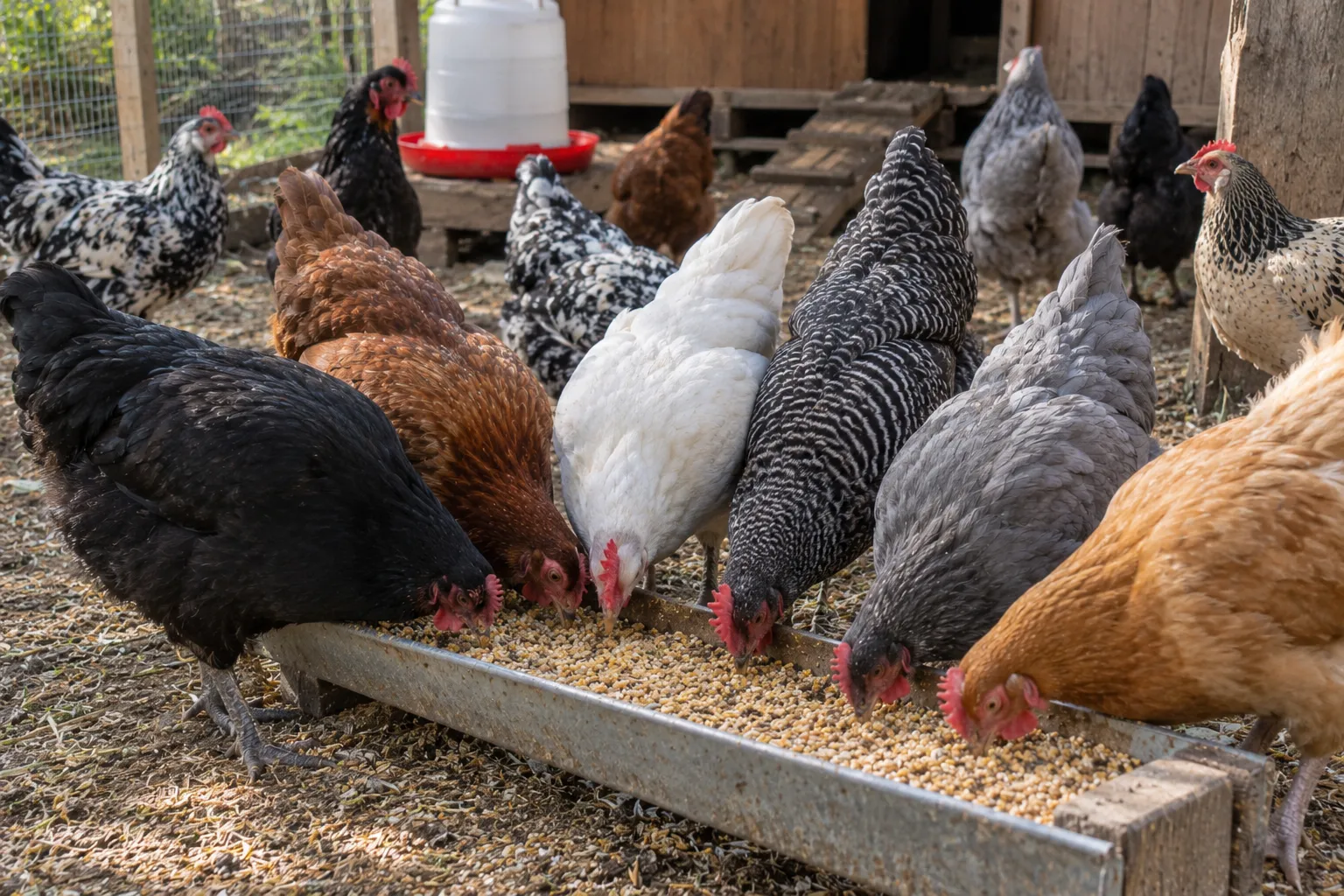
The best approach is to use a complete feed suited to your chickens’ breed, age and production status and to monitor intake regularly. Because it is hard to measure exactly how many insects or how much greenery free-ranging chickens eat in the yard, a drop in commercial feed intake should not be read directly as a sign of adequate nutrition.
Grains, bread and kitchen scraps should not replace the basic feed. Giving too much of these foods reduces intake of the balanced feed and can lead to nutrient deficiencies.
4. How many grams of feed does a rooster eat per day?
Roosters also need feed; however, because they do not produce eggs, their nutritional requirements are not exactly the same as those of hens.
The main factors affecting a rooster’s intake are:
- Body weight and build
- Age and growth stage
- Daily activity level
- Air temperature
- Energy density of the feed used
A small rooster may eat less than a large one. Even so, it is not accurate to give a single standard gram amount for roosters. About 80–150 g (2.8–5.3 oz) per day is an approximate range that can be used for initial planning for adult roosters. Intake can also be above 150 g (5.3 oz) per day.
Another important point is the choice of feed. Feeding roosters only a high-calcium feed formulated for laying hens over a long period may not be appropriate.
5. How much water do chickens drink per day?
Water intake is at least as important as feed intake. Chickens use water not only to quench their thirst but also to regulate body temperature, support digestion and sustain egg production.
Under suitable temperature conditions, poultry can generally drink about twice as much water as the feed they eat. The water-to-feed ratio, however, can range from about 1.5 to 3.5 times depending on conditions. So for a laying hen eating 100 g (3.5 oz) of feed, drinking around 200–300 ml (6.8–10.1 fl oz) of water is a reasonable estimate. This is not an upper limit; intake can be higher, especially in hot weather.
The most important rule: Do not think of the calculated amount as the total water to give the hen. Clean, fresh drinking water should be available at all times throughout the day. When chickens’ access to water is restricted, feed intake and egg production can suffer.
6. Under what conditions do feed and water intake change?
To interpret chickens’ daily intake correctly, you need to look not only at the gram amount but also at that day’s environmental and management conditions.
1. In hot weather
As the temperature rises, chickens drink more water to maintain their body temperature and generally eat less feed. As a result, energy and nutrient intake can fall. Continuous access to water is especially important at high temperatures.
2. In cold weather
The energy chickens spend maintaining their body temperature can increase. For this reason, feed intake may rise, especially at low temperatures. The size of the increase, however, depends on wind, housing conditions, feather cover and the energy value of the feed.
3. Energy density of the feed
A chicken fed a high-energy feed can meet its daily energy needs by eating less feed. On low-energy feeds, it may need to eat more. However, simply increasing the amount of feed does not necessarily solve amino acid or mineral deficiencies.
4. Free-ranging and activity
Chickens that roam the yard may need more energy because of their activity. On the other hand, the seeds and insects they find can reduce their intake of commercial feed. So free-ranging chickens eating less feed does not always mean they need fewer nutrients.
5. Egg production and age
Egg production increases nutrient requirements. The needs of young, growing birds also differ from those of adults. In older hens, nutrient requirements may change as egg production declines; however, it cannot be said that older hens will necessarily eat less.
6. Feeder and waterer conditions
Unsuitable feeders, spilled feed, too few waterers or some hens being unable to reach the water all affect actual intake. Feeders and waterers should be clean, accessible and suitable for every hen in the flock.
7. How much can water intake increase in hot weather?
The effect of temperature on water intake is quite marked. In a review published by the National Academies on environmental conditions and animal nutrition, chickens’ water intake was reported to double at 32 °C (90 °F) and rise 2.5-fold at 37 °C (99 °F) compared with the level at about 21 °C (70 °F). These are results from specific research conditions; they do not mean the same increase will occur in every coop.
For example, a hen that drinks 250 ml (8.5 fl oz) of water under normal conditions may need 500 ml (16.9 fl oz) or more under heat stress.
In hot weather:
- Keep water available at all times throughout the day.
- Keep the water clean, fresh and as cool as possible.
- Do not leave waterers in direct sunlight.
- Use more than one waterer so that every hen can reach water.
- Monitor changes in feed intake, egg production and behavior.
A drop in feed intake can be expected in hot weather; however, a marked and sudden drop should not be blamed on the heat alone. Disease, a problem with access to water or spoiled feed are also possible causes. Going without water for more than 12 hours can impair growth in young poultry and egg production in laying hens.
Sources
- Merck Veterinary Manual — Nutritional Requirements of Poultry
- . Merck Veterinary Manual — Management of Backyard Poultry
- Merck Veterinary Manual — Feeding and Management Practices in Poultry
- National Academies Press — Effect of Environment on Nutrient Requirements of Domestic Animals
- . National Academies Press — Effect of Environment on Nutrient Requirements of Domestic Animals: Feed Intake
- Colorado State University Extension – Practical Feeding Methods for Small Poultry Flocks
- Poultry Science (2018) — Broiler breeder rooster
Have a question about this topic? Email us via the contact page.